Travel Writer Rick Steves Finds a 'Wonderland' in Tangier, a 35-Minute Ferry Ride From Spain
In his weekly column, Edmonds-based guidebook author Rick Steves describes Tangier, Morocco, as a city whose main attractions are the everyday scenes in its streets.
By Jennifer Paige ·
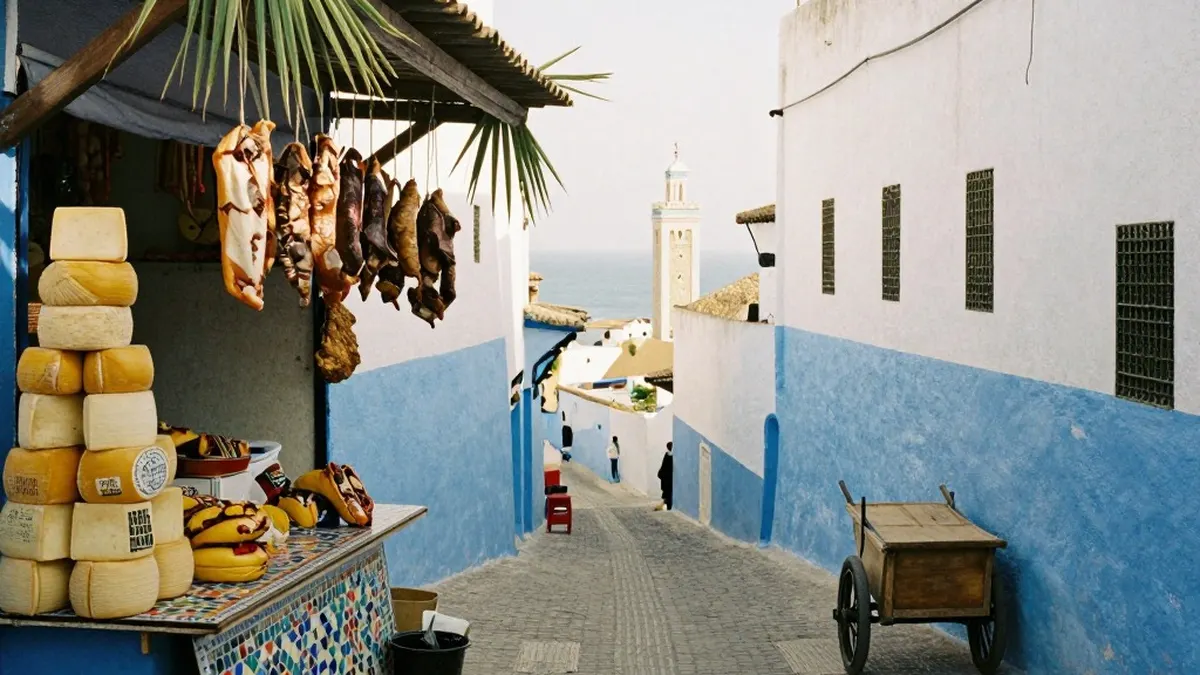
Tangier, Morocco, sits directly across the Strait of Gibraltar from Spain, and Edmonds resident Rick Steves says it feels like another world despite the short distance. In his column published Saturday, the guidebook author and public television host recounted a birthday spent in the city, which he said wakes up to roosters even more than to the call to prayer from the minarets.
Steves reached Tangier on a 35-minute ferry ride from Tarifa, on Spain's southern coast. Like most Moroccan cities, he wrote, it is divided into a new town and an old town, or medina. The old town is ringed by a medieval wall and holds colorful markets, twisty hilly streets and the Kasbah, home to a palace and a mosque. The Grand Socco, a big, noisy square, links the old and new districts. Tangier has few museums and formal attractions, Steves said, but it does not need them, because its sights are "living in the streets."
To mark his birthday, Steves spent a couple of hours alone in the back alleys. In the market just off the Grand Socco, he saw a butcher hanging entrails like a colorful curtain and Berber tribeswomen selling goat cheese wrapped in palm leaves. A man pushing a rickety cart loaded with a huge side of beef made a honking sound as he moved through the crowd. Steves first took it for a joke, then realized the man's voice was the only horn he had for his small-time delivery work.
Nearby, the clicking of a mosaic maker drew Steves into a tiny shop, where a craftsman spent his days chiseling mosaic chips for a commissioned pattern. The chips are made deliberately imperfect, Steves wrote, because only Allah is perfect and imperfection is therefore considered beautiful.
Steves also described the shared services that many Tangier residents rely on because they cannot afford private ovens, phones or running water. These include phone desks, public baths and neighborhood bakeries where people drop off dough to be baked. He followed a woman in a colorful scarf into one such bakery, where the baker used a broom-handled wooden spatula to move fish, stews, bread, cookies and sunflower seed pods in and out of the oven.
With his TV crew, Steves took a taxi up to the Kasbah and noticed a smiling boy who had jumped onto the back of the cab for a ride. The boy hopped off safely when the car was about to stop. At the top of old Tangier, Place de la Kasbah holds the Dar el-Makhzen, a former sultan's palace that is now a history museum. Tour groups there also meet snake charmers, water vendors and dance troupes. Steves said the ocean view should not be missed, and noted that the artist Henri Matisse visited in 1912-13 and drew on the culture, patterns and colors he found.
Most tourists in Tangier are day-trippers from resorts in southern Spain, Steves wrote, but he prefers to stay overnight in a riad, a guesthouse with rooms around a courtyard atrium. He recommended exploring the medina after dark, when the lanes and squares become even more alluring. He said recent upgrades have given the city an affluent, modern side without abandoning its roots, and he praised the warmth of Moroccan people, including the habit of touching the right hand to the heart after a handshake or a thank-you to show sincerity.
Steves concluded by asking how anyone staying in southern Spain could fail to make the short trip to "experience this wonderland." The column is part of a series revisiting his favorite places from the past two decades.
Source: The Everett Herald